
Higher education institutions often treat course catalogs, program finders, and program pages as interchangeable parts of their academic content ecosystem. This approach can create confusion for prospective students and miss critical opportunities to guide them through their decision-making journey.
Each tool serves a distinct purpose, addresses different audiences, and functions at specific student lifecycle stages. When institutions fail to differentiate between them, they risk overwhelming prospects with dense academic details too early or leaving current students without the necessary authoritative information.
Understanding how these three components differ and designing each with its specific audience and purpose in mind can transform your institution's ability to attract, engage, and convert prospective students while continuing to effectively serve your current academic community.
Primary audience: Current students, faculty, and administrators
Tone and purpose: Authoritative, comprehensive, and archival
Your course catalog functions as your institution's official academic record. It details every approved course, program requirement, and academic policy. This comprehensive resource serves as the authoritative source for:
Degree and certificate requirements
Complete course descriptions with prerequisites and credit hours
Academic policies, procedures, and regulations
Governance-approved updates that reflect accreditation standards
The catalog exists primarily to meet compliance and record-keeping requirements. Its dense, text-heavy format reflects this purpose. It's designed to document programs thoroughly, not to market them persuasively.
The problem arises when institutions use the catalog as their primary tool for attracting prospective students. New prospects scanning a catalog encounter overwhelming academic jargon, lengthy policy descriptions, and little visual appeal. They need inspiration and clarity, but the catalog delivers exhaustive documentation instead.
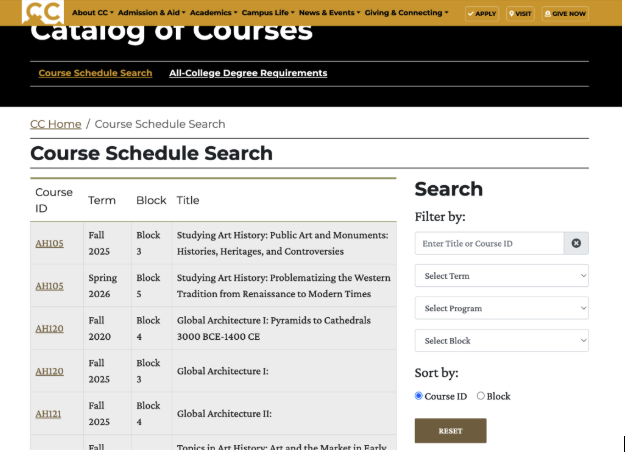
Here’s an example of a course catalog on Colorado College’s site:
Primary audience: Prospective students exploring their options
Tone and purpose: Conversational, exploratory, and personalized
The program finder bridges the gap between initial curiosity and serious consideration. It's where future students begin exploring your academic offerings before they've settled on a specific path.
An effective program finder helps users discover programs through:
Search and filter functionality by interest area, degree level, career outcomes, location, or delivery format
Brief, student-focused summaries that highlight key benefits and outcomes
Clear calls to action such as "Learn More," "Request Information," or "Apply Now"
Mobile-optimized design that supports exploration on any device
The best program finders prioritize ease of discovery over comprehensive detail. They guide students toward the next step in their journey rather than attempting to provide every specification up front. Think of it as the browsing stage: students compare options and seek programs that align with their interests and goals.
John Carroll University’s program finder is a great example: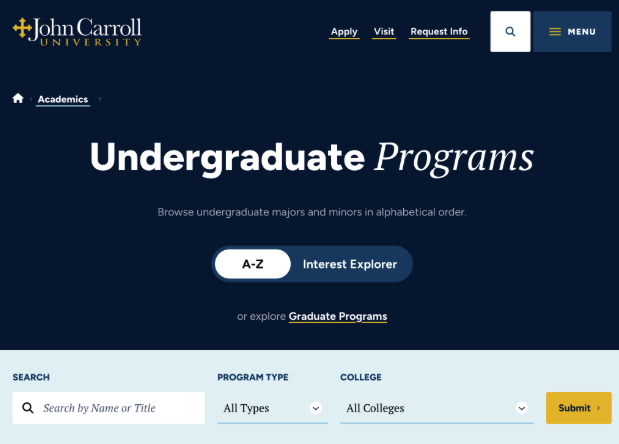
Primary audience: Prospective students ready to evaluate and decide
Tone and purpose: Inspirational, informative, and conversion-focused
When students enter a specific program, they transition from exploration to evaluation. They're asking, "Is this program right for me?" Your program page must answer that question compellingly.
A strong program page includes:
A clear, benefit-driven overview that answers "Why this program?" from the student's perspective
Career outcomes and pathways with concrete examples of where graduates work and thrive
Alumni success stories that demonstrate real-world impact
Faculty expertise highlights the people who will guide their education
Admission requirements and next steps with prominent conversion-focused CTAs
A link to the official course catalog for students who want complete academic details
Program pages should tell stories about transformation, opportunity, and success. They need visual appeal, scannable formatting, and SEO optimization. This is where prospective students envision themselves succeeding at your institution—make that vision as vivid and compelling as possible.
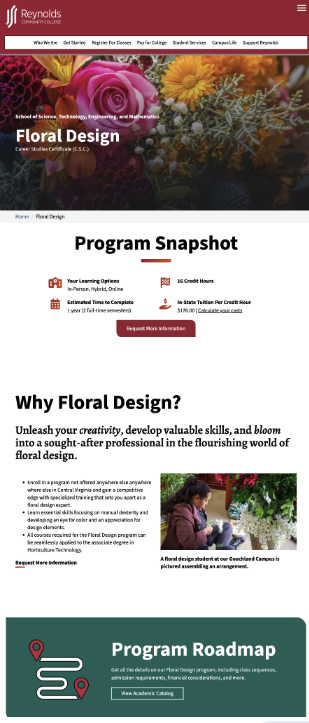
Here’s an example of a Program Page on Reynold’s Community College’s website:
Blurring the lines between these three tools creates problems for everyone:
Prospective students get lost in dense academic requirements before they've connected emotionally with a program. They leave your site without understanding why your programs matter or how they lead to meaningful careers.
Marketing teams miss opportunities to craft compelling narratives about student success, faculty expertise, and distinctive program features. They're constrained by catalog-style formatting that prioritizes compliance over conversion.
Current students and faculty struggle to locate accurate course information when it's buried in marketing-focused content or when updates aren't reflected consistently across platforms.
Web teams are constantly requested to update the same information in multiple places, increasing the risk of inconsistencies and errors.
Separating these tools while ensuring they remain interconnected creates a seamless journey:
Discover through the program finder
Decide via the program page
Verify with the course catalog
Each stage provides exactly what students need at that moment, moving them smoothly from initial interest to informed enrollment decision.
Maintain comprehensive, governance-approved documentation
Use consistent formatting and clear organizational structure
Update regularly to reflect current academic requirements
Make it easily searchable for current students and faculty
Don't expect it to serve as a marketing tool
Design for mobile-first exploration
Implement robust filtering and search capabilities
Write concise, benefit-focused program descriptions (2-3 sentences)
Include clear visual hierarchy and white space
Update regularly as new programs launch
Lead with outcomes and career possibilities
Include authentic student and alumni voices
Use compelling imagery that reflects the student experience
Optimize for search engines with relevant keywords
Place conversion-focused CTAs prominently throughout
Link to the catalog for complete academic specifications
Cascade CMS enables institutions to manage these three distinct experiences strategically without duplicating effort or sacrificing accuracy.
Structured content allows you to maintain one authoritative source for academic data while presenting it differently across your catalog, finder, and program pages. Update information once, and it flows to all relevant locations automatically.
Scheduled publishing and Publish Sets ensure that when requirements change, or new courses are added, those updates cascade across all three representations without manual intervention.
Personalization with Clive lets you tailor messaging, program recommendations, and calls to action based on user behavior, declared interests, and stage in the enrollment journey.
You don't have to choose between maintaining accurate academic records and creating compelling marketing experiences, because a well-structured CMS lets you accomplish both simultaneously.
Your academic content should guide students from initial inspiration through detailed information to decisive action. Each tool in your ecosystem plays a specific role:
The program finder sparks interest and facilitates discovery. The program page builds conviction and drives conversion. The course catalog provides verification and serves as the official record.
When you design each tool with its specific audience and purpose, you create a user experience that respects where students are in their journey. You provide exactly what they need, when needed, in the format that serves them best.
This approach improves usability, builds trust with prospective students who appreciate clear, relevant information, increases engagement by meeting students where they are, and, most importantly, improves enrollment outcomes by removing friction from the decision-making process.
Your academic content ecosystem should work as hard as your admissions team to attract, engage, and convert the right students for your programs. By distinguishing between course catalogs, program finders, and program pages and aligning each with its intended audience, you create a seamless journey that serves everyone better.
If someone asked you if higher ed marketing was B2B or B2C, your initial reaction would likely be “B2C”. After all,
To learn more about how Cascade CMS and Clive Web Personalization can help your institution reach more students than ever before, reach out to our team.
Last Updated: Jul 21, 2026 9:00 AM