
A few years ago, personalization in higher education was considered a great opportunity if you had the luxury of implementing it. Next, we realized that personalization is no longer optional but an expectation your audience has. And now, as higher ed faces mounting pressure from the demographic enrollment cliff, international recruitment challenges, and tightening budgets, personalization has evolved from a luxury to a lifeline.
The idea of personalization is simple: audiences ranging from prospective students to alumni anticipate content that resonates with their unique interests. When implemented thoughtfully, personalization boosts engagement, improves outcomes, and enhances user satisfaction.
But let’s clarify one thing: personalization must always be ethical. That means prioritizing user privacy, accessibility, and fairness. At Hannon Hill, we believe you don’t need names or email addresses, just behavior patterns and a commitment to inclusion to create meaningful, respectful digital experiences.
Here are some considerations.
Personalization doesn’t require sensitive data. You can deliver compelling, context-aware experiences without ever collecting someone’s name.
Use anonymous session data to read “digital body language.” Tools like Clive focus on what the user does instead of who they are. Actions like visiting a program page or returning to the admissions section are enough to drive intelligent and effective personalization. You can also personalize content based on which search terms someone used on your site or how often they’ve visited (and when).
Avoid personally identifiable information (PII). Don’t use data like names, email addresses, or device IDs unless users have opted in.
Transparency is key. Your privacy policy should be transparent about how data is collected and used, and users should be given control over personalization settings when possible.
As mentioned above, you can deliver a great personalized experience without collecting massive amounts of data about a visitor. As you build out your personas and segments, think about the behavioral triggers that would give you the confidence to assign a segment to a visitor on your site. Instead of targeting based on sensitive demographics or inferred personal characteristics, focus on behavior and declared intent.
For example:
Show relevant program information to users who’ve visited a specific department multiple times. (Here’s how the University of New Mexico College of Pharmacy is doing this.)
Adjust CTAs for users who return frequently or accessed a form page but didn’t submit it.
Personalize based on declared interests (for example, someone who chooses “Transfer Student” in a drop-down or clicked on an ad geared towards military or veterans), not IP address or assumed age.
Ethical segmentation balances value with respect.
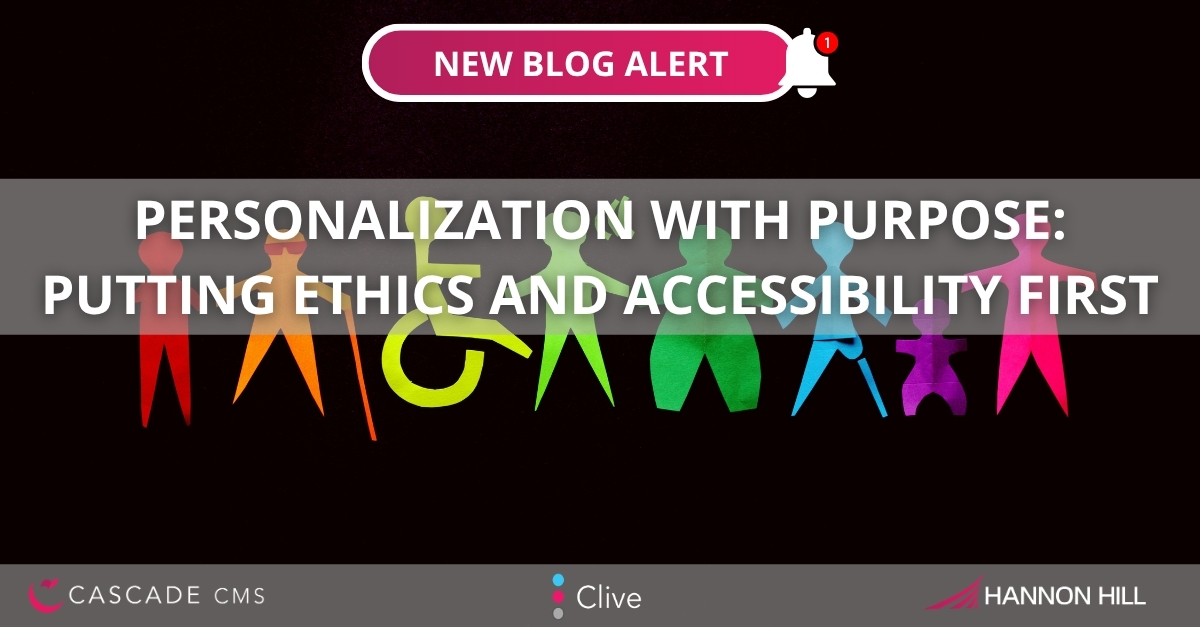
If your personalized content isn’t accessible, it isn’t truly inclusive. Every version of a page, whether it is personalized or not, must meet WCAG standards.
Dynamic or swapped content should be correctly announced to assistive technology in order to ensure screen reader compatibility.
Personalized components, if they’re interactive, must be fully operable without a mouse, so always preserve keyword navigation.
Watch out for poor contrast or erratic features or components that could disrupt usability.
Accessible personalization ensures that no user is left behind.
Personalization should enhance the content, not gate it. Every visitor deserves full access to a site’s information and functionality, regardless of how you know about them. Don’t reserve your “best” content or experience only for users who have given you personal information or, worse, the most data. It’s essential to ensure all pathways lead to complete and inclusive information.
While personalization can create more relevant and engaging experiences, there’s a fine line between helpful and invasive. Over-personalizing, such as referencing too many user behaviors or inferring details the user hasn’t explicitly shared, can make visitors feel stalked rather than welcomed. Instead, aim for subtle, high-impact touches, such as a headline that acknowledges a user’s location (think a welcome message in the language of your visitor’s country), a call-to-action aligned with their browsing behavior, or featured content tied to previously viewed pages. For instance, a prospective student explores the Biology undergraduate program and navigates to the admissions page. The next time they return to the homepage, they see a personalized call-to-action that references the Biology program and invites them to request info. These light, contextual cues enhance the experience without crossing into discomfort. Effective personalization should feel like a thoughtful concierge, not a chaperone.
Personalization isn’t a set-it-and-forget-it strategy. You must continually evaluate it for fairness, accessibility, and effectiveness. Be sure to develop a review plan and cadence, test variations with screen readers and keyboard-only navigation, solicit user feedback, especially from those using assistive technologies, and review rules and segments to eliminate bias and ensure equitable treatment across all user types.
At Hannon Hill, our tools are built for thoughtful, inclusive digital experiences. With Clive, you can personalize content using anonymous session data and user behavior without compromising privacy or accessibility.
Whether tailoring your homepage for prospective students or showing relevant events to returning users, Clive gives you powerful capabilities with ethical boundaries baked in. When paired with Cascade CMS, your team has full control over content quality, governance, and accessibility, no matter how personalized the experience.
Let’s personalize with purpose:
Prioritizing privacy and transparency.
Ensuring accessibility in every variation.
Avoiding over-targeting and two-tiered content experiences.
Embracing ethical segmentation based on behavior, not identity.
Don’t over-personalize.
Auditing and improving personalization strategies over time.
When personalization is ethical, inclusive, and transparent, it improves digital experiences, builds trust, and drives better outcomes for everyone.
Let's talk! Don't hesitate to contact us if you want tailored guidance on your content strategy or a demonstration of how Cascade CMS balances flexibility with brand protection.
To learn more about how Cascade CMS and Clive Web Personalization can help your institution reach more students than ever before, reach out to our team.
Last Updated: Sep 3, 2026 9:00 AM